
For: African importers, wholesalers, procurement teams, manufacturers and trading businesses buying goods from China.
Key takeaways
- ▸Confirm the supplier's registered legal name and beneficiary account before sending funds.
- ▸Agree the invoice currency and exact amount the supplier must receive.
- ▸Prepare your company's KYB documents and the underlying trade documents.
- ▸Compare the full cost, including FX and payment fees, rather than the headline exchange rate alone.
- ▸Treat a change of bank details as a new verification event.
- ▸Consider escrow for eligible first-time, higher-value or higher-risk transactions.
The basic payment process
Paying a Chinese supplier should be treated as a controlled business process, not simply an international transfer. The strongest workflow is:
- ▸Register and complete KYB. KeyBS reviews the business, its ownership, expected activity and supporting documents.
- ▸Add the supplier and invoice. Provide the supplier's legal name, invoice, bank details and transaction purpose.
- ▸Verify the supplier and beneficiary. Check the Chinese business record and whether the beneficiary details are consistent with the entity being paid.
- ▸Receive a quote. Review the funding currency, CNY receive amount, exchange rate, fees, expected route and indicative settlement window.
- ▸Fund through an approved method. Available methods depend on the customer's country, currency, compliance status and active partner route.
- ▸Settle and reconcile. The approved CNY payment is routed to the supplier's mainland bank account and recorded against the invoice.

What currency will the supplier receive?
KeyBS Pay's published China corridor supports approved CNY/RMB settlement into mainland Chinese bank accounts. This can help an eligible supplier receive a domestic Chinese payment rather than requiring the buyer to arrange an international foreign-currency wire.
CNY and CNH are both forms of renminbi, but they refer to different markets:
| Term | Practical meaning | Relevance to this payment |
|---|---|---|
| CNY | Renminbi used in mainland China's onshore market | KeyBS's published China route settles approved invoices in CNY to eligible mainland bank accounts |
| CNH | Renminbi traded in offshore markets | May appear in international pricing or offshore arrangements, but it should not be assumed to be the settlement currency |
| USD or another contract currency | A supplier may quote in a foreign currency | Confirm whether the invoice will remain in that currency or be converted for CNY settlement |
Do not decide based only on the currency symbol shown on a quotation. Ask three questions:
- ▸What currency is the invoice legally denominated in?
- ▸What currency and exact amount must the supplier receive?
- ▸Which beneficiary account is authorized to receive it?
The rate and receive amount should appear on the transaction quote before approval.
Documents you may need
Requirements vary by customer, corridor, amount, product type and compliance assessment. A typical application or transaction may require the following.
Business onboarding documents
- ▸Certificate of incorporation or business registration
- ▸Ownership and director information
- ▸Identification for relevant directors and beneficial owners
- ▸Proof of registered or operating address
- ▸Description of the business and expected payment activity
- ▸Source-of-funds or source-of-wealth information when requested
Review the current KeyBS Pay KYC, KYB and EDD requirements before applying.
Supplier and transaction documents
- ▸Commercial or pro forma invoice
- ▸Supplier's registered Chinese legal name
- ▸Beneficiary account name and bank details
- ▸Description of the goods and payment purpose
- ▸Purchase order or sales contract, where applicable
- ▸Packing list, bill of lading or customs documents, where applicable
- ▸Additional evidence requested during compliance review
There is no universal document threshold that applies identically to every incoming supplier payment. KeyBS or the relevant financial-institution partner will confirm what is required for the actual route and transaction.
Verify the supplier before funding
The supplier's trading name, website name and beneficiary name may differ. That difference is not automatically fraudulent, but it must be explained and verified before money moves.
At minimum, check:
- ▸Registered Chinese company name
- ▸Current business-registration status
- ▸Unified Social Credit Code, where available
- ▸Incorporation date and business scope
- ▸Beneficiary account name
- ▸Sanctions and adverse-risk indicators
- ▸Any unexplained change to the payment account
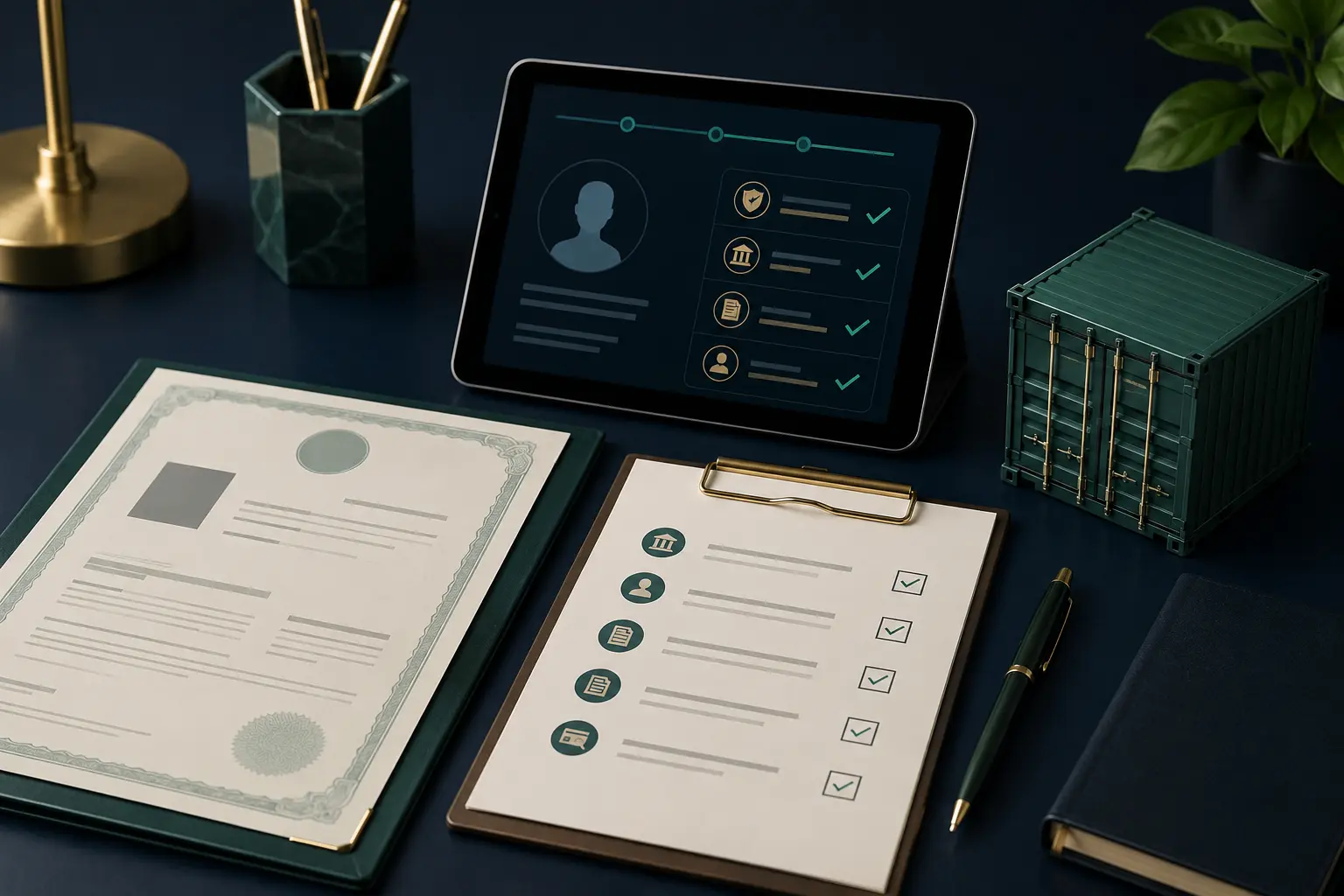
A compromised email account can send convincing replacement bank details during a legitimate transaction. If the beneficiary changes, pause the payment and confirm the new details through a previously established, independent communication channel.
Verify a Chinese supplier before paying.
Which funding currencies are supported?
The current Pay to China page states that eligible customers may fund supported China payments using GHS, NGN, KES, ZAR, USD, GBP or USDT, subject to corridor and partner-route approval.
Availability must be confirmed for the customer and transaction. A currency appearing on the website does not guarantee that every funding method, amount or route is available to every business.
What does the payment cost?
The total cost can include:
- ▸The exchange rate applied to the funding currency and CNY
- ▸Payment-processing or route fees
- ▸Supplier-verification fees, where applicable
- ▸Escrow or enhanced-verification fees, if selected
- ▸Charges imposed by third-party banks or providers, where applicable
The best comparison is the total amount the buyer pays against the exact CNY amount the supplier receives. KeyBS uses corridor-specific or quote-based pricing and presents the applicable rate and fees before the customer confirms the transaction.
Illustrative process example
Assume a Ghanaian importer has an approved invoice from a supplier in Shenzhen. The importer submits the invoice, supplier information and mainland beneficiary account. KeyBS reviews the route and returns a quote showing:
- ▸Funding currency and funding amount
- ▸CNY amount expected by the supplier
- ▸Exchange rate
- ▸Itemized fees
- ▸Expected settlement window
- ▸Quote validity period
The importer should approve and fund only after checking that the registered supplier, invoice party and beneficiary details are consistent. This example illustrates the process; it is not a live quote, price promise or confirmation that a particular route is available.
How long will settlement take?
There is no single settlement time for every Africa-to-China payment. Timing can be affected by:
- ▸Origin country and funding method
- ▸Time and day the funds are received
- ▸Quote acceptance and cut-off times
- ▸Completeness of the invoice and supporting documents
- ▸Customer, supplier and transaction review
- ▸Receiving-bank processing
- ▸Partner-route availability
Same-day settlement may be available for eligible transactions when funding, documentation, compliance and cut-off requirements are completed in time. The expected window shown for the specific quote is the relevant estimate; it is not a guarantee.
Bank transfer, specialist payment platform or escrow?
| Method | May suit | Considerations |
|---|---|---|
| International bank transfer | Established supplier relationships or contracts that require a conventional wire | Correspondent fees, receive-amount uncertainty and longer routing chains may apply |
| CNY supplier-payment platform | Eligible African businesses that want coordinated FX, verification and domestic CNY delivery | Availability and pricing remain route-, document- and compliance-dependent |
| Letter of credit | Larger transactions requiring bank-controlled documentary conditions | More documentation, bank processes and costs |
| Marketplace protection | Purchases completed within a marketplace's eligible programme | Protection usually applies only when every programme condition is followed |
| Trade escrow | Eligible first-time, higher-value or higher-risk transactions | Release conditions, fees, eligibility and responsibility for inspecting goods must be agreed clearly |
No method removes all risk. Payment security depends on supplier verification, correct beneficiary details, appropriate commercial terms and control over when funds are released.
When should you consider trade escrow?
Escrow may be appropriate when:
- ▸The supplier is new to the buyer
- ▸A large deposit or full advance payment is requested
- ▸Goods are customized or difficult to resell
- ▸Release should depend on defined documents, inspection or delivery milestones
- ▸The potential loss would materially affect the buyer's business
KeyBS Pay offers Trade Escrow on eligible trades and corridors. The parties must understand the release conditions, evidence requirements, fees and exclusions before funding. Escrow reduces specific transaction risks but does not itself verify product quality or guarantee a successful trade.
A practical checklist before you pay
- ▸Complete business KYB and provide accurate expected-activity information
- ▸Confirm the supplier's registered Chinese legal name
- ▸Confirm the beneficiary account belongs to the approved entity or document the relationship
- ▸Match the invoice, contract, payment purpose and beneficiary details
- ▸Independently verify any bank-detail change
- ▸Confirm the invoice currency and exact supplier receive amount
- ▸Review the exchange rate, itemized fees and quote expiry
- ▸Check the indicative settlement window and cut-off requirements
- ▸Consider escrow or additional inspection for higher-risk transactions
- ▸Retain the invoice, verification result, quote and payment confirmation
Frequently asked questions
Can an African business pay a Chinese supplier directly in CNY?
KeyBS Pay states that eligible African businesses can settle approved Chinese supplier invoices in CNY to supported mainland Chinese bank accounts. Each transaction remains subject to KYB/KYC, AML review, documentation, partner approval and route availability.
Can I fund the payment in my local currency?
The published route identifies GHS, NGN, KES and ZAR among the supported funding currencies, along with USD, GBP and USDT. Availability depends on the customer, funding method and active route and should be confirmed through the quote.
What documents are normally requested?
Businesses generally need onboarding documents plus the supplier invoice, beneficiary details and transaction purpose. Purchase orders, contracts, shipping documents or additional source-of-funds evidence may also be requested depending on the transaction.
Is CNH the same as CNY?
Both refer to renminbi, but CNY generally describes the mainland onshore market and CNH the offshore market. KeyBS's published China supplier-payment proposition is CNY settlement into eligible mainland accounts; do not assume that CNH is the delivery currency.
Can KeyBS verify the Chinese supplier?
KeyBS offers registry-backed supplier verification and beneficiary checks. These can inform the decision and identify inconsistencies, but they do not guarantee supplier performance, goods, delivery or recovery of funds.
Does KeyBS guarantee a settlement time?
No. Settlement timing is route-dependent. A quote may show an expected window, but funding, documentation, compliance checks, cut-off times, receiving-bank processing and partner availability can affect completion.
Is escrow available for every China payment?
No. Escrow is available only for eligible trades and corridors and is subject to agreed release conditions, compliance review, jurisdiction and partner availability.
Ready to pay an approved Chinese supplier?
Get a route-specific quote showing the funding amount, CNY receive amount, exchange rate, applicable fees and indicative settlement window before you commit.
Request an Africa-to-China payment quote
Review the Pay to China service
About the author
Patrick Mensah is CEO of KeyBS Pay, an Africa-focused B2B financial-technology platform providing cross-border payment, FX, treasury and international trade-payment tools. He writes about the operating challenges African businesses face when paying and collecting across global markets.
Compliance review: Doreen Anokyewaa Appiah, Director of Compliance. Last reviewed: 4 September 2026.
Important information
KeyBS Pay is a technology platform and not a bank. Services are provided directly or through regulated financial-institution partners where applicable and are subject to eligibility, jurisdiction, KYB/KYC, AML and transaction review, and partner-route approval. Coverage, currencies, funding methods, pricing and timing are route-dependent. Supplier verification and escrow reduce particular risks but do not eliminate fraud, performance, product-quality or delivery risk. This article is general information and not legal, tax or financial advice.
Sources
- ▸KeyBS Pay — Pay to China, accessed 4 September 2026.
- ▸KeyBS Pay — Global Supplier Payments, accessed 4 September 2026.
- ▸KeyBS Pay — Supplier Verification, accessed 4 September 2026.
- ▸KeyBS Pay — KYC, KYB and EDD Requirements, accessed 4 September 2026.
- ▸KeyBS Pay — Trade Escrow, accessed 4 September 2026.