B2B cross-border payment fees by corridor depend on the origin and destination, the currency pair, the routing rail, and who bears each charge. The total cost of a supplier invoice is the sending fee, the FX spread, intermediary and receiving-bank deductions, and any local rail charges. Compare the net amount the supplier receives, not the headline fee.
This guide sets out the fee stack for business payments, shows how African trade corridors differ, and explains how to choose a route for each invoice. All figures in the examples are hypothetical.
Key Takeaways
- ▸Assess each corridor by currency pair, routing rail, charge option (OUR, SHA or BEN) and local requirements.
- ▸Compare the supplier's net received amount, including the FX spread, rather than the sending fee alone.
- ▸Local rails and SWIFT carry different deduction risks; the right route depends on destination, currency, amount and timing.
- ▸Verify the supplier and beneficiary account before funds move: Verify. Then pay.
What makes up the fee stack on a business supplier payment?
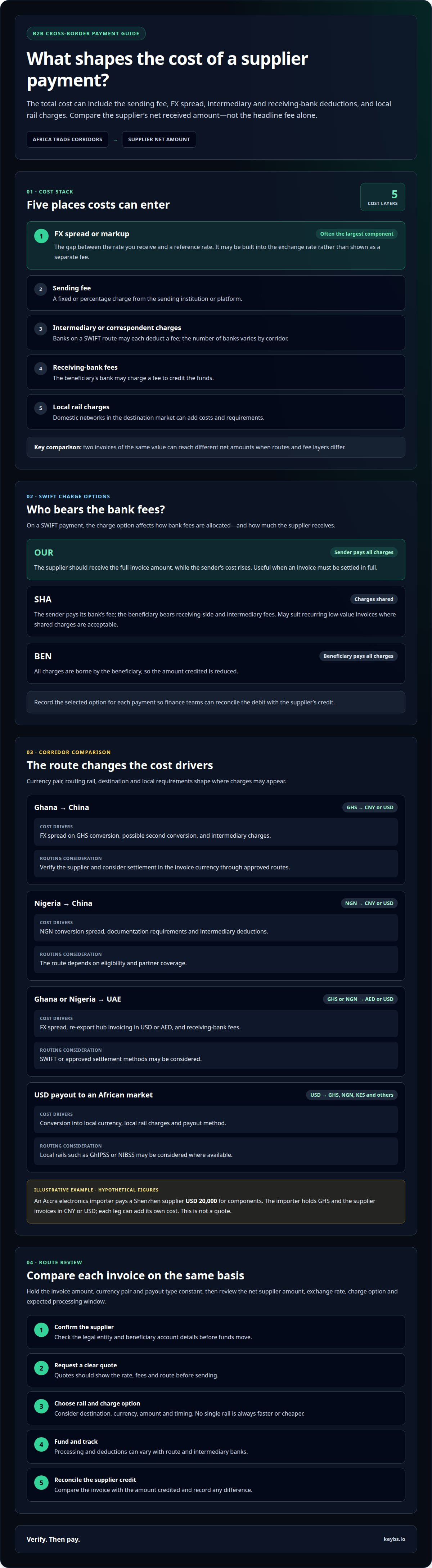
A supplier payment can carry five cost layers. Some are shown before you send; others are deducted along the route or built into the rate.
- ▸Sending fee: a fixed or percentage charge from the sending institution or platform.
- ▸FX spread or markup: the gap between the rate you receive and a reference rate. It is often the largest component and rarely appears as a separate line.
- ▸Intermediary or correspondent charges: banks on a SWIFT route may each deduct a fee, and the number of banks varies by corridor.
- ▸Receiving-bank fees: the beneficiary's bank may charge to credit the funds.
- ▸Local rail charges: domestic networks in the destination market can add their own costs and requirements.
Because the layers differ by route, two invoices of the same value can land at different net amounts. Regulatory charges and taxes depend on destination-country rules, so check the central bank or revenue authority of the market concerned, such as the Bank of Ghana or the Central Bank of Nigeria. Rules change.
How do OUR, SHA and BEN charge options change what the supplier receives?
On a SWIFT payment, the charge option decides who pays the bank fees.
- ▸OUR: the sender pays all charges, so the supplier should receive the full invoice amount, though the sender's cost rises.
- ▸SHA: charges are shared. The sender pays its bank's fee and the beneficiary bears the receiving-side and intermediary fees.
- ▸BEN: the beneficiary bears all charges, and the amount credited is reduced.
For a invoice that must be settled in full, such as a factory demanding the exact invoiced sum before release of goods, OUR avoids short payments. For recurring low-value invoices, SHA may be acceptable. Record the chosen option on each payment so finance teams can reconcile any difference between the debit and the supplier's credit.
Should you route through SWIFT or a local rail?
SWIFT offers broad bank-to-bank reach, but timing and deductions vary with the intermediary banks. It is often used for larger or less common corridors. Local rails, such as GhIPSS in Ghana, NIBSS in Nigeria, SEPA in the euro area, ACH in the United States or Faster Payments in the UK, can reduce deductions on supported routes. No single rail is always faster or cheaper.
The decision turns on four inputs: destination, currency, amount and timing. A euro invoice to an EU supplier may suit SEPA where eligible, while a payment to a less common destination may need SWIFT. Stablecoin-supported legs are another option on eligible routes, subject to jurisdiction, compliance approval and partner availability.
How do African trade corridors compare?
Illustrative example: an Accra electronics importer pays a Shenzhen supplier USD 20,000 for components. The importer holds GHS, the supplier invoices in CNY or USD, and each leg adds its own cost. The figures are hypothetical and are not quotes.
| Corridor type | Typical currency pair | Main cost drivers | Routing considerations |
|---|---|---|---|
| Ghana to China | GHS to CNY or USD | FX spread on GHS conversion, possible second conversion, intermediary charges | Supplier verification and CNY invoice settlement through approved routes |
| Nigeria to China | NGN to CNY or USD | NGN conversion spread, documentation requirements, intermediary deductions | Route depends on eligibility and partner coverage |
| Ghana or Nigeria to UAE | GHS or NGN to AED or USD | FX spread, re-export hub invoicing in USD or AED, receiving-bank fees | SWIFT or approved settlement methods |
| USD payouts to Africa | USD to GHS, NGN, KES and others | Conversion into local currency, local rail charges, payout method | Local rails such as GhIPSS or NIBSS where available |
The pattern is consistent: the more conversions and intermediaries in the chain, the more places a cost can enter. Holding balances in the invoice currency between orders can avoid unnecessary conversions on recurring corridors.
How do you choose a payment route by corridor?
Hold the variables constant and compare. For each corridor, fix the invoice amount, currency pair and payout type, then compare the net supplier amount, the exchange rate, the charge option and the expected processing window.
- ▸Confirm the supplier's legal entity and account details.
- ▸Request a quote showing the rate, fees and route.
- ▸Select the rail and charge option.
- ▸Fund the payment and track settlement.
- ▸Reconcile the invoice against the supplier's credit.
Large tickets may justify a separate FX conversation, so compare the quoted rate and route for high-value invoices before you fund them.
How does KeyBS Pay support supplier payments?
KeyBS Pay is a B2B technology platform operated by KEYBS FINANCE LLC, a Registered Money Services Business with FinCEN (Reg. No. 31000337575912). KeyBS Pay is not a bank; regulated services are provided through licensed partners where applicable. Its principle is "Verify. Then pay.": registry-backed supplier checks and beneficiary account checks happen before funds move.
Supplier Payments follow the flow Verify, Approve, Pay, Track, with registry-backed supplier checks and a quote showing the FX rate, fee summary and route before sending. Global Payouts reach up to 190+ countries through partner infrastructure using local rails, real-time schemes, stablecoins and wallets. Fees are disclosed before each transaction, with no hidden fees, and may include transaction fees, currency conversion spreads and express settlement fees.
Availability, fees and timing depend on corridor, eligibility, KYB/KYC, AML review and partner approval. Services are unavailable where restricted by law, and users must be at least 18 or of legal majority. Services are governed by the laws of Ghana, with disputes resolved by arbitration in Accra.
Frequently Asked Questions
What fees do banks charge for international payments by destination corridor?
There is no single fee. A payment may involve a sender wire charge, intermediary deductions, a receiving-bank charge and an FX margin. Separate the charges collected before sending from deductions made en route, then check the supplier's net amount.
How do payment fees vary by corridor, currency and amount?
Routes use different networks and conversions. A payment in a single currency avoids conversion, while an exchange adds a spread. Fixed charges weigh more on small invoices, and percentage-based costs weigh more on large ones.
What exchange-rate markups apply on major corridors?
Markups are usually built into the quoted rate. Compare the quoted rate with a reference rate and note any separate conversion line to see the true cost.
How do SWIFT intermediary and receiving-bank fees affect costs?
They can reduce the amount credited, depending on the charge option and the banks involved. Using OUR can protect the invoiced amount, at a higher cost to the sender.
Does the cheapest route hold as payment size grows?
Not necessarily. Recompare when the amount changes, keeping the corridor, currency pair and payout method the same.
Next step
Map your main corridors, record the charge option and compare net supplier amounts before you pay. Join KeyBS Pay Early Access to discuss your supplier payment needs.