A familiar bank wire isn’t automatically the best way to pay an overseas supplier. The right choice among international supplier payment methods depends on payment frequency, currencies, and the visibility and control your process needs. Bank transfers can suit straightforward transactions, while correspondent banking and unified payment platforms offer different ways to manage cross-border payments.
Choosing a payment route involves more than comparing transfer fees. Currency conversion, intermediary banks, processing times, recipient details, and compliance procedures can all affect a payment from initiation to delivery.
This guide compares bank transfers, correspondent banking, and unified payment accounts to help you assess their practical trade-offs. It also shows how to match a route to your payment pattern, whether you make occasional transfers or manage recurring supplier payments.
Key Takeaways
- ▸Compare transfer routes by currency handling, intermediary steps, processing requirements, and the level of payment control your supplier workflow needs.
- ▸Consider a letter of credit when payment depends on agreed delivery conditions and supporting documents, rather than relying on a direct transfer alone.
- ▸Assess whether managing domestic and cross-border payments through one account structure could simplify payment operations and oversight.
- ▸Match the payment method to the transaction’s risk, timing, and documentation requirements before setting a repeatable supplier payment process.
International bank transfers and correspondent banking
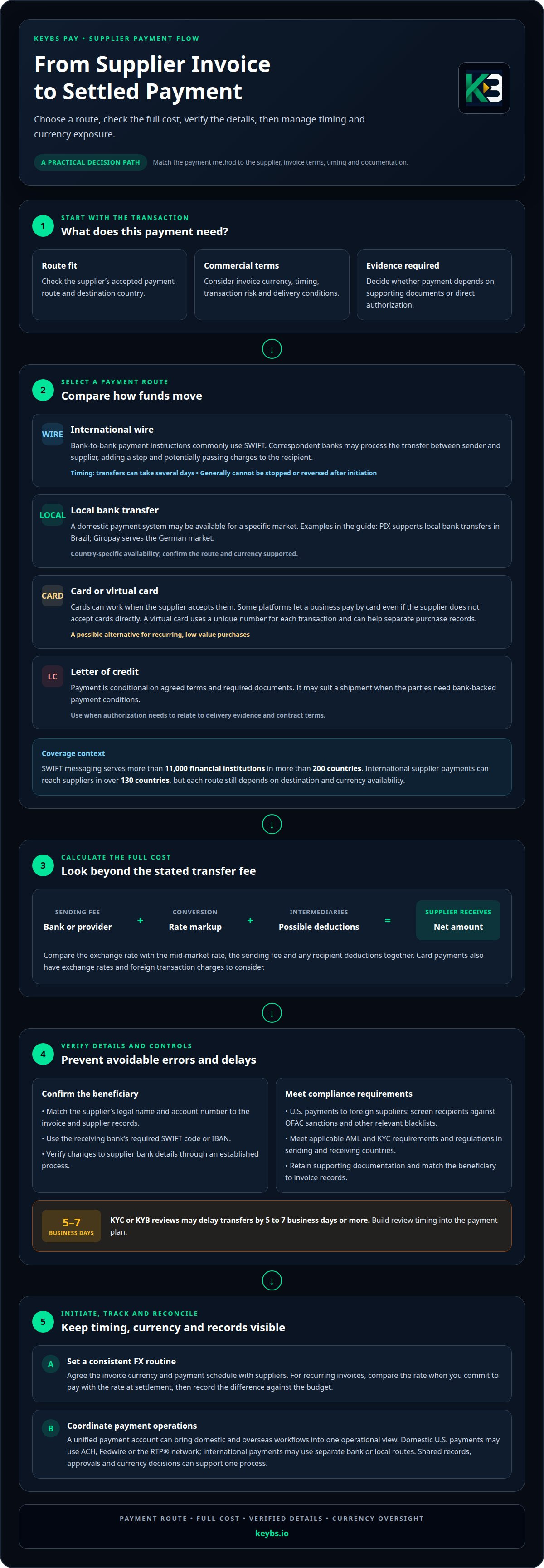
International bank transfers move funds between banks, often using correspondent banking relationships and SWIFT messaging. Before choosing a route, compare its exchange rate, fees, timing, and coverage for the recipient’s country.
International Wire Transfers
An international wire sends funds bank to bank, commonly using SWIFT to transmit payment instructions. SWIFT messaging serves more than 11,000 financial institutions in more than 200 countries, while transfers can take several days. Correspondent banks may process the payment between the sender and supplier, adding another step and potentially passing charges to the recipient. Unlike domestic ACH, international wires support cross-border payments.
Exchange Rates and Transaction Fees
Compare the full conversion cost, not just the stated transfer fee. Banks and payment providers may add a markup to the mid-market exchange rate, while intermediary charges can reduce the amount the supplier receives. Card payments follow a different route, but their exchange rates and foreign transaction charges also affect the total. Review the exchange rate, sending fee, and any recipient deductions together.
Transfer Limits and Country Availability
Transfer limits depend on the bank, account controls, payment purpose, and destination country. Availability also varies by route: PIX supports local bank transfers in Brazil, while Giropay serves the German market. International supplier payments can reach suppliers in over 130 countries, but that does not mean every bank route supports every destination or currency. Confirm the receiving bank’s details and required SWIFT code or IBAN before initiating payment.
Foreign Exchange Risk
Businesses can manage foreign-exchange risk by agreeing on the invoice currency with suppliers, setting a payment schedule, and reviewing exchange rates before payment. For recurring invoices, compare the rate when you commit to pay with the rate at settlement, then record the difference against the budget. FX exposure arises when the payable currency changes in value before conversion. Consistent timing and currency policies make that exposure easier to track.
| Option | Route | FX and fees | Coverage |
|---|---|---|---|
| International wire | Bank and correspondent network | Sending and intermediary charges; possible rate markup | Cross-border, route-dependent |
| Local bank transfer | Domestic payment system | Depends on conversion and receiving route | Country-specific, such as Brazil’s PIX |
| Credit card | Card network | Exchange rate and card charges apply | Supplier acceptance-dependent |
Choose a route that matches the supplier’s country, currency, required timing, and total conversion cost.
What’s the Best Way to Pay International Suppliers?
The right route depends on whether the transaction calls for card processing, conditional bank-backed payment, or a direct transfer. Compare international supplier payment methods against the supplier’s accepted route, invoice terms, and required documentation before agreeing how funds will move.
For U.S. payments to foreign suppliers, screen recipients against OFAC sanctions and other relevant blacklists, and meet applicable AML and KYC requirements. Payments must also comply with regulations in both sending and receiving countries.
Fraud, incorrect beneficiary details, processing delays, and compliance reviews can disrupt a supplier payment. Build controls around the transaction: verify changes to supplier bank details through an established process, match the beneficiary to invoice records, and retain supporting documentation. International wires generally cannot be stopped or reversed after initiation, while KYC or KYB reviews may delay transfers by 5 to 7 business days or more.
Credit cards can be useful when suppliers accept them, and some platforms let businesses pay by card even when suppliers don’t accept cards directly. Virtual cards use a unique number for each transaction, helping separate purchase records. For recurring, low-value purchases, a virtual card may be a practical alternative to processing every payment through a bank transfer.
A letter of credit makes payment conditional on agreed terms and required documents. It may suit a shipment where the parties need bank-backed payment conditions, while cards are better suited to purchases that can be authorized directly. The useful comparison among international supplier payment methods is not just the instrument, but how payment authorization relates to delivery evidence and contract terms.
Choose a route that aligns transaction controls with the commercial agreement. For a structured view of supplier payment workflows, consider how each route fits your controls.
Domestic and international supplier payments in one account
A unified payment account can bring domestic and overseas supplier workflows into one operational view. U.S. businesses may use ACH, Fedwire, or the RTP® network for domestic payments, while international payments may follow separate bank or local payment routes. The operational benefit is coordination: payment records, approval steps, and currency decisions can follow a shared process.
Local account details can give suppliers a familiar way to send funds in their country or currency. For outgoing payments, record the supplier’s legal name, account number, and the receiving bank’s SWIFT code or IBAN. Match these details against the invoice and supplier records before paying to reduce errors from mistyped information or mismatched beneficiary names.
International supplier payments typically require the recipient’s name, account number, and the receiving bank’s SWIFT code or IBAN. Use the exact details required for the chosen route, then retain the invoice and approval record with the transaction.
Multi-currency balances can help separate funds by currency and make conversion decisions easier to see. For example, a U.S. buyer invoiced in euros can track the euro payable alongside its dollar budget. This does not remove exchange-rate exposure, but it makes the currency obligation easier to reconcile and review before payment.
Accounting integration matters because payment records need to align with invoices, supplier ledgers, and reconciliation workflows. Link each payment reference to its invoice, record the currency and converted amount, and flag intermediary charges that affect the received total. This creates a clearer process for period-end checks.
Open-account terms shift payment timing rather than changing the transfer route. In international sales, payment may fall due 30, 60, or 90 days after goods are shipped and delivered. Buyers can plan cash requirements around the due date, while suppliers carry the risk of waiting for payment. Compare that credit period with the operational control and records available through a unified workflow.
International payments and cross-border commerce
International payments are part of a wider commercial chain involving invoices, shipment milestones, currencies, and settlement. The global cross-border payment market, including traditional and cryptocurrency payments, reached nearly $1 quadrillion in 2024. That scale makes payment design an operational consideration, not simply a final step after a purchase. A U.S. importer should align payment timing with the supplier’s invoice and the commercial agreement.
Payment infrastructure differs by region and currency. SEPA supports euro bank-to-bank transfers across 35 member countries in Europe, with transfers typically taking 1-2 business days. International invoice ACH transfers can take up to 7 days. These routes are not interchangeable: match the payment network to the destination, currency, and invoice requirements, then account for its processing timeline when planning settlement.
Trade terms determine when money moves. With cash in advance, an exporter receives payment before transferring ownership of the goods. Documentary collections let an importer pay at sight or accept a draft due on a specified date, but they don’t verify payment or provide much recourse if the importer fails to pay. Distinguish document handling from a bank’s commitment to pay.
Foreign exchange settlement is another part of the commercial structure. CLS settles foreign exchange transactions in the currencies of its 18 members, settling both sides simultaneously to address settlement risk. CLS is not a supplier payment route; it illustrates how currency conversion and payment settlement involve separate infrastructure. Record the invoice currency, conversion decision, payment route, and amount received for each transaction.
For international transactions, coordinate the invoice, delivery conditions, currency, and payment timing before funds are sent. That creates a clearer audit trail and helps teams identify mismatches between shipment documents and payment records. Plan your cross-border payment workflow around those commercial controls.
KeyBS Pay: Payment Links
KeyBS Pay offers Payment Links for workflows that collect payments, alongside Supplier Payments for businesses making outgoing supplier transactions. The distinction matters: collecting a payment and paying a supplier serve different purposes, even when they are part of the same cross-border transaction.
For businesses reviewing their payment operations, KeyBS Pay’s E-Invoicing and Checkout can support related invoice and payment workflows. Consider how each step connects to invoice records, approvals, currency decisions, and reconciliation. This can help determine whether a payment link fits the transaction or a supplier payment route better matches the direction of funds.
Visit keybs.io to learn more about KeyBS Pay’s payment offerings.
Make payment policy part of procurement
Use your next supplier contract to establish a repeatable payment policy. Define who approves new beneficiary details, which currencies the business will pay in, and how finance records invoice-to-payment decisions. A documented process gives procurement and finance a shared basis for handling exceptions, reviewing changes, and maintaining consistent controls as supplier relationships develop.
Choosing among international supplier payment methods is only one part of that policy. The operating workflow should also connect payment instructions to invoice records and approval responsibilities. KeyBS Pay offers Payment Links, E-Invoicing, and Checkout to help businesses structure connected payment workflows.
If you’re reviewing how your current setup supports supplier transactions, discuss the workflow and control requirements with KeyBS Pay. Contact KeyBS Pay to discuss your payment setup and take a considered next step toward a process that fits your business.
Frequently Asked Questions
What are international payments?
International payments involve a payer and recipient in different countries. For a U.S. business paying an overseas supplier, the process may involve converting dollars into the invoice currency, routing funds through financial institutions, and matching the transfer to a commercial invoice. Distinguish the payment instruction from the underlying trade obligation: the transfer moves funds, while the contract defines what those funds settle.
Do you have an online platform to make transfers?
Yes. KeyBS Pay is a B2B technology platform, not a bank; regulated services are provided through licensed partners. Access is subject to KYB/KYC, AML, partner approval, and jurisdictional requirements, with ongoing monitoring and possible suspension for non-compliance. Services are unavailable where restricted by law. Users must be 18 or the legal age of majority. Ghanaian law governs services, and disputes are resolved by arbitration under the governing terms.
How long do transfers take to clear?
Timing depends on the payment route, currency, processing cutoffs, intermediary institutions, and compliance review. A payment may be submitted before the receiving bank posts funds to the supplier’s account, so distinguish submission from when funds are available to the recipient. Align the invoice due date with the route’s processing stages and allow time for bank review or corrections to beneficiary details.
How much does it cost?
KeyBS Pay’s fees depend on the payment corridor, currency, transaction amount, funding method, and settlement method. Fees are disclosed upfront before each transaction, with no hidden fees. Depending on the selected product and transaction, charges may include transaction fees, currency-conversion spreads, account-maintenance fees where applicable, or express-settlement fees. Review the disclosure for the applicable route and product before authorizing payment.
What are the main ways to pay international suppliers?
Common options include international bank transfers, local payment rails, credit or virtual cards, and trade instruments such as letters of credit or documentary collections. Open-account terms set payment after shipment rather than choosing a transfer rail. To narrow the options, start with the supplier’s accepted route, then match payment timing and documentary controls to the contract. A shipment requiring bank-checked documents calls for a different structure from routine invoice settlement.
How do international wire transfers work, and what do they cost?
An international wire instructs the sending bank to transfer funds to the supplier’s bank, often using SWIFT messaging and correspondent institutions. The total cost may include the sending bank’s transfer fee, intermediary deductions, and a currency-conversion spread. Compare the amount debited from your account with the amount the supplier expects to receive: a low stated wire fee alone doesn’t reveal the full transaction cost.