A supplier invoice and an overseas customer’s card payment may cross the same border, but they serve different purposes. Cross-border business payments are transfers between businesses in different countries to pay for goods, services, or other commercial obligations. The payment method, currencies involved, and requirements in each country shape how the funds move and what the recipient receives.
It’s reasonable to expect an international transfer to work much like a domestic one, but additional steps can affect processing, documentation, and the final amount delivered. This article explains how B2B transfers work, how they differ from business-to-customer payments, and how payment types, tax and regulatory requirements, and exchange-rate changes can affect a transaction. The aim is to clarify the operational factors behind a cross-border payment so you can assess their relevance to your business.
Key Takeaways
- ▸Map the tax, data-protection, sanctions, and compliance requirements that apply in both countries before setting payment procedures.
- ▸Assess which currency the invoice uses and when conversion occurs, since exchange-rate movements can change the amount received.
- ▸Compare transfer methods by how funds are routed, what information the transaction requires, and how intermediaries may affect timing and visibility.
- ▸Choose a workflow that matches the payment direction: Payment Links can support customer collections, while Supplier Payments address business disbursements.
Country-specific tax and regulatory differences
International payments can involve different tax, financial-crime, sanctions, and data rules in the sending and receiving countries. A process that works in one country may not meet the requirements in another.
Country-Level Tax Requirements
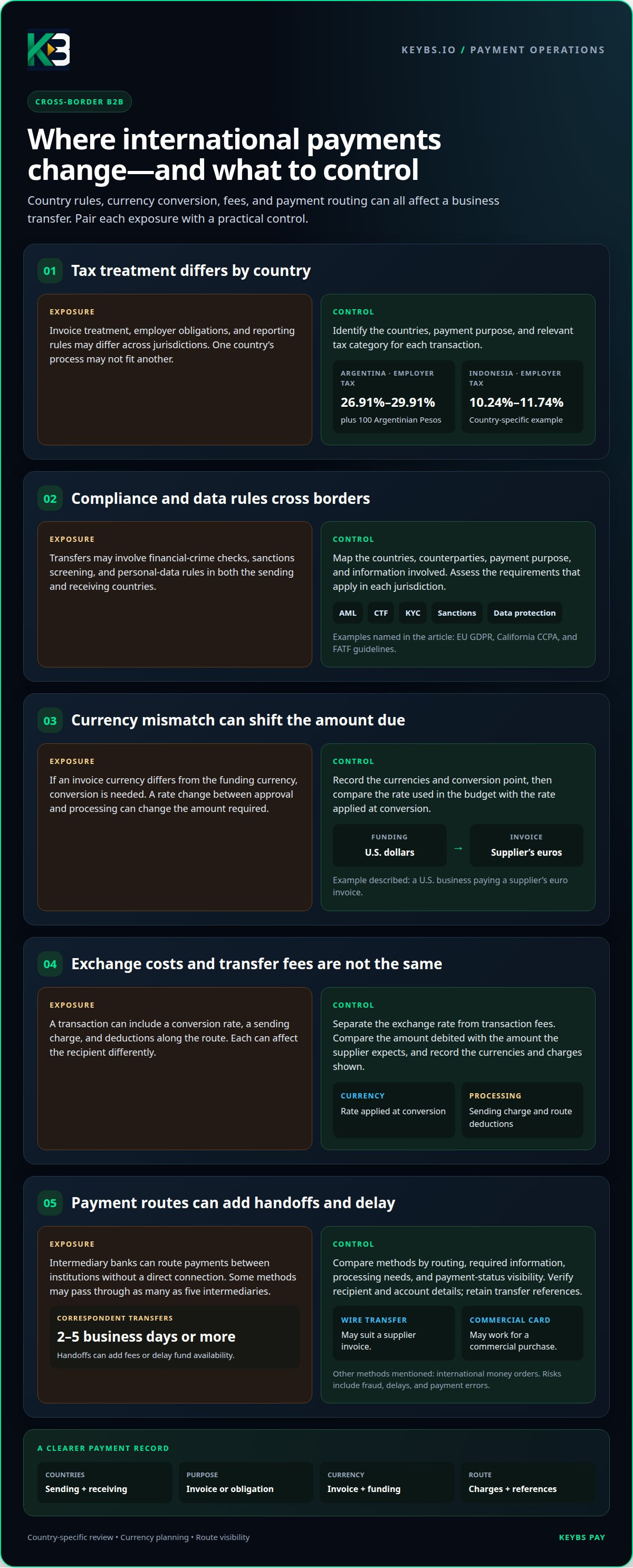
Country-level tax requirements are the taxes and reporting rules attached to commercial payments in each jurisdiction. They matter because invoice treatment, employer obligations, and recordkeeping can differ across a border. Employer tax figures list Argentina at 26.91%-29.91%, plus 100 Argentinian Pesos, and Indonesia at 10.24%-11.74%. These examples show why businesses need country-specific classifications rather than assuming one tax treatment applies globally. For each transaction, identify the countries involved, payment purpose, and relevant tax category.
Regulatory and Data Privacy Requirements
Regulatory and privacy requirements govern financial checks and the handling of transaction information across borders. They matter because international payments may involve anti-money-laundering (AML), counter-terrorism financing (CTF), and Know Your Customer (KYC) checks. Identify the requirements that apply in both the sending and receiving countries, including relevant sanctions and data-protection rules.
The European Union’s General Data Protection Regulation (GDPR) sets strict requirements for processing and transferring personal data in the EU. California’s Consumer Privacy Act (CCPA) is another example of a data privacy and security law. If payment records contain personal information, map where it is collected, used, and transferred before setting up the workflow. These rules can affect who accesses data, how long it is retained, and how it is shared among payment participants.
For cross-border compliance, assess each country’s rules rather than treating a bank account or payment route as a substitute for review. FATF guidelines are part of the international framework for financial compliance. A practical control is to document the countries, counterparties, payment purpose, and information involved, then assess the applicable AML, CTF, KYC, sanctions, and privacy requirements. This record helps teams apply consistent procedures while accounting for differences between countries.
Foreign exchange rules and fluctuating exchange rates
A cross-border transaction may require currency conversion before settlement. The exchange rate, conversion timing, and transfer fees all affect how much the recipient receives.
Foreign Exchange Management
Foreign exchange management means planning how a business holds, converts, and pays in different currencies. This matters when an invoice currency differs from a supplier’s preferred currency. For example, a U.S. business paying a supplier’s euro invoice needs to account for converting dollars to euros. For each payment, record the invoice currency, funding currency, conversion point, and expected settlement amount.
Exchange Rate Volatility
Exchange-rate volatility is the change in one currency’s value against another between transaction stages. A rate change between invoice approval and payment processing can alter the amount required in dollars. As a result, a dollar-denominated budget may differ from the amount needed to settle a foreign-currency invoice. Track the rate used in the budget and compare it with the rate applied at conversion.
When reviewing the amount delivered, separate the exchange rate from transaction fees. A transfer may involve a conversion rate, a sending charge, and deductions along the payment route, each affecting the recipient differently. Compare the amount debited from the business with the amount the supplier expects, and record the currencies and charges shown. This helps distinguish exchange costs from processing costs.
Timing is another control point. If funds are converted after an invoice is approved, the rate may differ from one applied earlier. Set a payment policy that defines who approves currency conversion, which rate informs forecasts, and how rate changes are recorded. Consistent records for recurring supplier payments make it easier to compare exchange outcomes across invoices.
For supplier disbursements, structured payment workflows can support clearer operational handling alongside currency planning.
What are B2B cross-border payments?
B2B cross-border payments move funds between businesses in different countries. A U.S. company paying an overseas supplier is one example.
International Business Use Cases
International business payments cover commercial obligations between businesses, such as supplier invoices, service fees, and customer receipts. For example, a U.S. manufacturer might pay a foreign parts supplier, while an overseas distributor pays for U.S. inventory. The payment purpose, recipient details, and currency can all affect processing. Keep each invoice linked to its payment so finance teams can reconcile the obligation with the funds sent.
Cross-Border Payment Methods
Businesses use methods such as wire transfers, commercial cards, and international money orders to move funds across borders. The right fit depends on the country and currency, transaction purpose, recipient details, processing needs, and security controls. Before choosing a method, compare how it routes funds and records payment status. A wire may suit a supplier invoice, for example, while a card may work for a commercial purchase.
Intermediary Banks and Payment Delays
Intermediary banks help route payments between financial institutions without a direct connection. Correspondent banking is the most prevalent arrangement, and some payment methods may pass through as many as five intermediaries. Each handoff can add fees or delay fund availability; correspondent transfers can take 2-5 business days or more. Risks include fraud, delays, and payment errors, so verify recipient and account details, retain transfer references, and match confirmations to invoices.
U.S. businesses can track and reconcile payments by recording the invoice, currency, recipient, transfer reference, and settlement status in one ledger. Compare those records with bank statements and supplier confirmations, and investigate mismatches before closing the invoice.
Payment Networks and Interoperability
Payment networks connect institutions and systems, while interoperability determines whether they can exchange payment instructions. SWIFT supports cross-border transactions among financial institutions and some large corporate organizations. ISO 20022 is a global messaging standard used to improve interoperability. More than 70 countries had adopted some form of real-time payment system as of early 2025, but network connections vary. Thailand and Singapore directly connected their instant payment networks in late 2023, illustrating how linked systems can support cross-border transfers.
B2B and B2C cross-border payments
The key distinction is who pays whom and why. A business-to-business (B2B) payment settles a commercial obligation between companies, such as an invoice for components. A business-to-customer (B2C) payment moves funds between a business and an individual, such as a customer paying an online retailer. These differences shape payment initiation, records, and reconciliation.
For B2B transactions, the buyer typically pays against an invoice, purchase order, or service agreement. The recipient is another business, and finance teams need to match the transfer to that obligation. A U.S. company purchasing components from a foreign manufacturer may need to track the invoice currency, amount sent, and amount credited. Commercial card payments for cross-border B2B transactions typically settle in 1-2 days. This timing can affect cash planning and supplier reconciliation.
B2C payments often begin at checkout, where an individual pays a business for a product or service. For example, an American customer ordering from an overseas retailer may pay by card, while the merchant receives settlement through its payment arrangement. The customer journey prioritizes a clear amount and payment experience; the business must still reconcile the transaction and account for any currency conversion. A payment method that works for individual purchases may not suit a large supplier invoice.
Traditional banking routes and newer payment networks can serve different transaction needs. Compare the payment direction, currency, invoice or order records, recipient requirements, processing path, and settlement information before choosing a provider. Businesses seeking to expand should also distinguish customer collection workflows from supplier disbursements, rather than treating every international transfer alike. That separation supports clearer controls and accounting across B2B and B2C activity.
To assess how your payment workflows support business and customer transactions, review cross-border payment options in the context of your operating model.
KeyBS Pay: Payment Links
KeyBS Pay offers Payment Links for businesses collecting payments from customers across borders. They connect a payment route to a commercial request, while E-Invoicing supports invoice workflows and Checkout supports online payment acceptance. For outgoing disbursements, Supplier Payments are designed for payments to suppliers. Choose the workflow based on whether you are collecting from a customer or paying a supplier, then link the payment record to its invoice or transaction purpose.
If your business is setting up international collections or supplier payments, contact KeyBS Pay to discuss the right payment workflow.
Build a payment workflow that can scale
Turn payment decisions into a repeatable operating process. Define who approves each transaction, which records the finance team retains, and how exceptions are escalated. These controls help keep international activity organized as supplier relationships and customer markets expand.
For customer collections, KeyBS Pay offers Payment Links, E-Invoicing, and Checkout. Choose the workflow that matches how customers are billed and pay, then align transaction records with your internal reconciliation process. Treat cross-border business payments as part of the wider finance workflow, not as isolated transfers.
To discuss how these payment options fit your business, contact KeyBS Pay about business payments. A clearly defined process gives your team a practical foundation for handling international transactions with greater consistency.
Frequently Asked Questions
What are cross-border business payments and how do they work?
Cross-border business payments are commercial payments sent between businesses in different countries. The payer provides transaction instructions, funds move through the relevant payment route, and the recipient receives the payment in the specified currency or after conversion. For example, a U.S. importer can pay an overseas supplier against an invoice. Finance teams can link the transfer reference to the invoice, purchase order, and accounting entry to maintain a clear audit trail.
What payment methods can U.S. businesses use to pay international suppliers?
U.S. businesses can use wire transfers, commercial cards, international money orders, or an online payment platform, depending on the supplier and payment route. A wire may suit a supplier invoice with formal banking details, while a commercial card may fit eligible purchases. Compare supported currencies, recipient information, transaction records, and the settlement process. ACH payments to an international supplier depend on whether the route and recipient account support them.
How much do international business payments cost, including fees and exchange-rate markups?
There is no universal cost. Charges depend on the route, currency conversion, funding method, and settlement method. Assess transfer charges separately from the exchange rate or any currency-conversion margin, and account for possible deductions along the payment route. KeyBS Pay pricing varies by corridor, currencies, transaction amount, and payment and settlement methods; route-specific pricing or a quotation may apply.
How long do cross-border business payments take by wire, ACH, card, and online payment platforms?
Timing depends on the payment method and route. SWIFT transfers can take 1-5 business days, while correspondent-bank transfers may take 2-5 business days or more. Commercial card payments for cross-border B2B transactions typically settle in 1-2 days. ACH and online platform timing depends on the supported corridor, processing steps, and recipient arrangements, so confirm the expected processing window shown for that transaction.
What information and documents are needed to send or receive an international business payment?
Prepare the payer’s and recipient’s business names, recipient account details, payment currency, amount, and purpose. An invoice or purchase order links the transfer to its commercial basis. For example, a supplier payment record should match the invoice reference and beneficiary details. Financial institutions or payment platforms may request supporting business information during review, so keep records of the parties and transaction consistent.
What U.S. regulations apply to cross-border business payments, including sanctions and AML checks?
U.S. cross-border payment workflows can involve sanctions screening, anti-money-laundering (AML) controls, and Know Your Customer (KYC) checks. Requirements may also depend on the destination country and the financial institutions handling the transfer. The parties, payment purpose, route, and information provided can shape the review. Maintain accurate transaction records and make sure payment details clearly identify the sender, recipient, and commercial purpose.