The same transfer amount can cost different amounts on different routes. International payment fees by corridor vary according to the origin and destination, currency pair, settlement method, and local rules. The total cost can include stated charges as well as costs built into the exchange rate.
A low transfer fee may look appealing, but it does not necessarily mean the recipient receives more. The exchange rate and any charges along the route also affect the amount delivered. Compare the total cost and recipient’s net amount on a like-for-like basis.
This guide explains how remittance corridors work, what shapes their costs, and how payment methods can differ from one route to another. You’ll see why the same method may suit one corridor but not another, and which cost components to consider when choosing how to send a cross-border payment.
Key Takeaways
- ▸Assess a corridor by its origin, destination, currency pair, settlement route, and local requirements, not just by the countries involved.
- ▸Compare the amount the recipient receives after exchange-rate conversion and route charges, rather than relying on the sender fee alone.
- ▸Use the transfer purpose, payout method, currency liquidity, and processing route to judge which payment method fits a corridor.
- ▸For business payment workflows, consider whether Payment Links, E-Invoicing, Checkout, or Supplier Payments align with how funds need to be collected or sent.
What Is a Remittance Corridor?
A payment corridor is the route between a sending country and a receiving country. It is defined by the origin, destination, currency pair, settlement method, and local regulatory conditions. A US-to-Mexico transfer and a US-to-India transfer are separate corridors, even if the same bank handles both. These factors shape international payment fees, processing, and payout by corridor.
Local payment-network fees, taxes, and regulatory charges depend on destination-country rules and the payout rail. A US-to-Mexico route may have a different charge structure from a US-to-India route because local networks and requirements differ. The destination and payment method determine which local costs apply.
Foreign-exchange movements also affect the amount received. If conversion takes place after the exchange rate changes, the recipient may receive a different amount than expected. For example, converting USD to EUR involves both the exchange rate applied and any margin built into it. A low visible transfer fee does not show the full conversion cost, so compare the quoted rate with the rate used at settlement.
Wire costs combine fixed charges and conversion-related costs. A fixed wire charge takes a larger share of a small transfer, while an exchange-rate margin affects the converted amount. A SWIFT payment may pass through one to three intermediary banks, each adding operational friction. Such transfers usually take 1-5 business days, so routing can affect both timing and total cost.
Average transaction costs also vary by corridor. In the second quarter of 2020, averages were reported separately for transfers from the United States to Mexico, China, and India. Those distinct routes show why one corridor’s typical cost cannot reliably represent another’s. Compare the sender charge, exchange rate, intermediary deductions, and recipient payout for the same transfer purpose and currency.
Types of remittance corridors, including crypto-based routes
Cross-border payment routes use different networks, payout methods, and intermediaries. For a bank-based transfer, the sender may use a bank or money transfer operator, while intermediary institutions and a local payout provider route funds to the recipient. Digital platforms can connect payment initiation with bank deposits, mobile wallets, or cash pickup. The corridor determines which participants process the transfer.
Some corridors are established bank routes, while others rely more heavily on digital wallets or mobile-money networks. The United States-to-Mexico corridor is the world’s largest remittance corridor, with remittances totaling $36 billion in 2019. US-to-China remittances totaled $14.3 billion that year, while US-to-India remittances totaled $12.74 billion. Those flows illustrate how routes can differ in scale and payout infrastructure.
Crypto-based routes use blockchain networks to move digital assets across borders, with conversion into local currency often handled separately. Although blockchain transfers are described as near-instant, access to usable funds depends on the conversion and payout arrangements. Compare the full route, from the sender’s funding method to the recipient’s final currency.
Cost reduction is a global policy objective. The United Nations Sustainable Development Goals set a target of reducing the average cost of international transfers to under 3%. This target highlights the gap between transfer charges and the intended affordability of remittances, but individual corridor costs still depend on networks, conversion, and payout design.
US consumers also have a cancellation period for covered remittance transfers. According to the Consumer Financial Protection Bureau, consumers generally have at least 30 minutes to cancel a transfer. This right matters if the sender spots an error after initiating payment; the transfer’s status and applicable process determine how cancellation is handled.
For businesses coordinating cross-border disbursements, global payout workflows can support payments across international routes.
What is a cross-border money transfer?
A cross-border transfer moves funds from a sender in one country to a recipient in another. Its route connects funding, currency exchange, payment infrastructure, and destination payout.
Transfer Steps and Cost Drivers
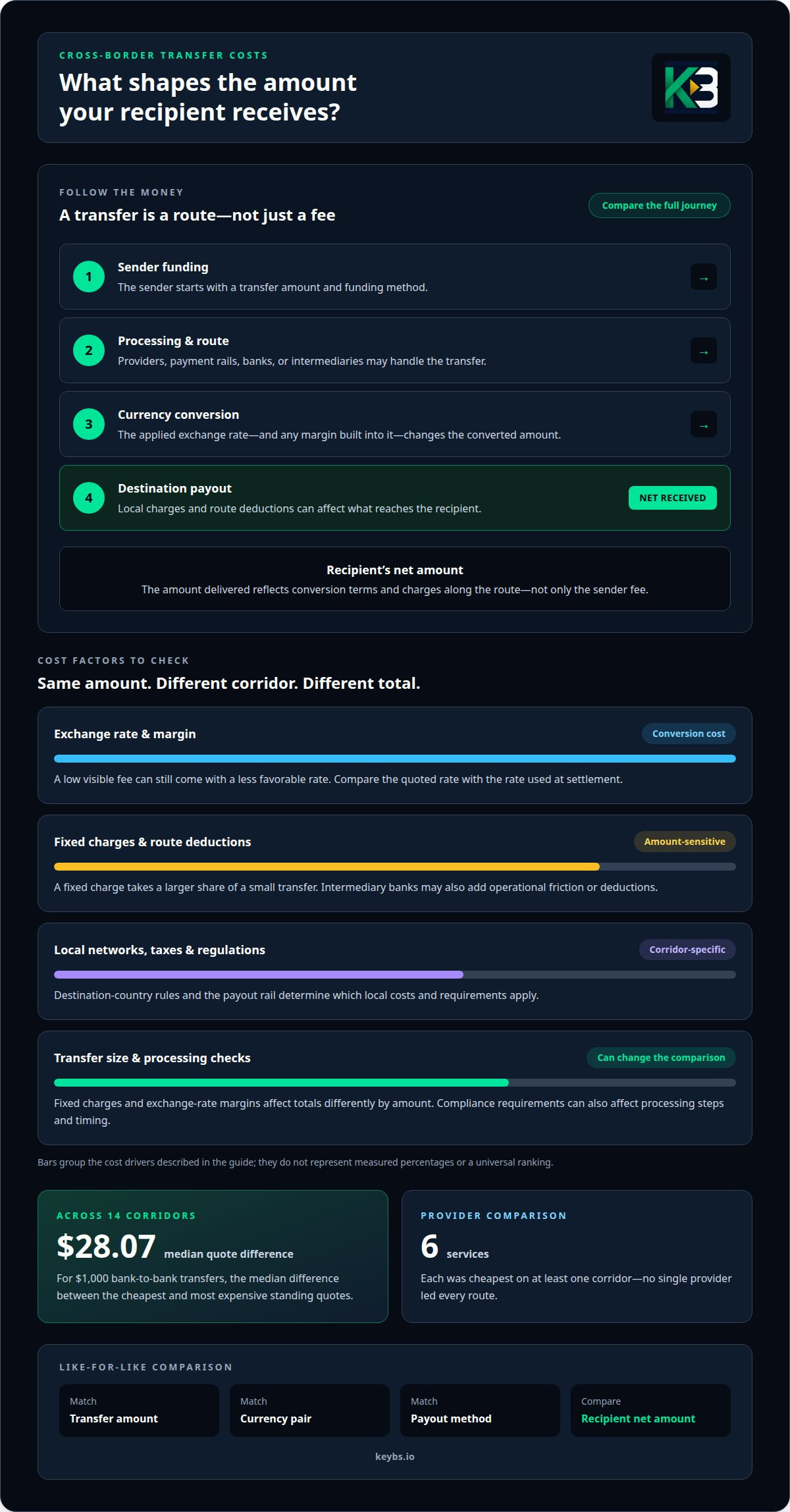
A transfer moves from sender funding through processing and any currency conversion to delivery at the destination. Each stage may involve a different provider, payment rail, or banking institution. The recipient’s final amount depends on more than the initial instruction: conversion terms and route deductions can change what arrives. For cross-border payments, compare the entire route and delivered amount, not just the payment interface.
Transfer Amounts and Provider Costs
The transfer amount can change which provider is cheapest because fixed charges and exchange-rate margins affect totals differently. A comparison of $1,000 bank-to-bank transfers across 14 international corridors found a median difference of $28.07 between the cheapest and most expensive standing quotes. Quotes were collected October 28-30, 2026. Six different money transfer services were cheapest on at least one corridor, so no provider led every route.
For a small transfer, a fixed charge can make up a larger share of the amount. For a larger transfer, the exchange rate and percentage-based costs may have more influence. The biggest difference between providers can therefore depend on both the country pair and transaction size. Compare the same amount, currency pair, and payout method for a useful comparison.
Compliance review is another part of transfer processing. Requirements can vary according to the country, payment purpose, sender and recipient details, and institutions handling the route. Checks may affect processing steps and timing, so accurate transaction information helps support smoother handling. The relevant infrastructure and review criteria depend on the corridor.
The exact price depends on the corridor, currency conversion, transfer amount, and payment route. KeyBS Pay provides route-specific pricing or a quote for your transaction.
Choosing a payment method by corridor
Choose a payment method based on the route’s settlement infrastructure, currency conversion, and recipient payout, rather than its headline fee alone. A bank transfer, digital platform, or wallet-based route can have different costs on the same corridor because each uses different payment networks and processing steps.
Start with the payment’s purpose and destination. For a business paying a supplier in France from Brazil, the corridor involves BRL-to-EUR conversion. Compare how each method handles the exchange rate, settlement, and delivery to the supplier. Fewer intermediaries may reduce friction, while local payout access and currency liquidity can shape the available options. The method must suit the recipient’s ability to receive funds, not just the sender’s preferred interface.
Then assess transaction size and frequency. Traditional cross-border transfers typically have all-in costs of 3% to 7% of payment value, so both fixed charges and percentage-based conversion costs matter. For recurring payments, compare the total impact across the payment schedule, including how each settlement cycle affects reconciliation. A method that suits a single transfer may not be practical for regular supplier payments.
Also consider payout format and timing requirements. A bank deposit, mobile wallet, or cash pickup depends on the destination’s payment networks, and the recipient’s available payout methods can narrow the choices. Digital platforms may settle transfers in minutes to hours, while traditional correspondent transfers can take longer. Speed alone does not determine value: consider conversion, settlement, and the recipient’s access to funds together.
For a consistent comparison, hold the corridor, transfer amount, currency pair, and payout type constant. Compare the amount received, exchange rate, transfer charges, settlement method, and processing time. Use the full cost and operational fit to select a method. Explore cross-border payment options for business transactions.
KeyBS Pay: Payment Links
KeyBS Pay offers Payment Links for businesses collecting payments across borders. They let businesses present a payment request to a customer, while the corridor still determines currency conversion, settlement, and the amount ultimately received.
For businesses managing multiple payment workflows, KeyBS Pay’s E-Invoicing and Checkout support payment collection, while Supplier Payments are for outgoing payments to suppliers. These options can align payment processes with how customers pay or suppliers receive funds. They do not remove corridor-specific costs, so assess the route and transaction requirements alongside the workflow.
To discuss how KeyBS Pay can support your business payment workflow, contact KeyBS Pay.
Build a repeatable payment decision
Make corridor selection part of a consistent operating practice. For each route, record the payment purpose, recipient’s needs, funding currency, destination currency, and preferred settlement approach. This gives you a baseline for evaluating international payment fees by corridor as transaction patterns change, without relying on a single headline charge for every decision.
For customer collections, match the workflow to how payers receive and process requests. KeyBS Pay offers Payment Links, E-Invoicing, and Checkout for businesses to assess against their collection process and cross-border requirements. Keep route-level assumptions visible to finance and operations teams so reconciliation and payment decisions stay aligned.
When your next payment workflow requires a route-specific assessment, contact KeyBS Pay to discuss your payment needs. A clear view of the transaction purpose and recipient requirements is a practical starting point for choosing the right operational approach.
Frequently Asked Questions
Does the Cheapest Option Hold as You Send More?
Not necessarily. The least expensive option can change as the transfer amount grows. A fixed charge weighs more heavily on a smaller payment, while a percentage-based exchange-rate margin scales with the amount converted. For recurring transfers, compare the total cost across the payment schedule, not just a single transaction. Keep the corridor, currency pair, and payout method consistent for a useful comparison.
What is a currency corridor?
A currency corridor describes a transfer between a specific origin and destination, together with the currencies used to fund and receive it. For example, a business paying a supplier in France from Brazil may need to account for BRL funding and EUR receipt. Identifying the corridor helps establish which exchange, payment networks, and payout arrangements apply to that route.
What fees do banks charge for international payments by destination corridor?
There is no single bank fee for every destination corridor. Depending on the route and transaction setup, a transfer may involve a sender-side wire charge, an intermediary deduction, a receiving-bank charge, or a conversion margin. For budgeting, separate charges collected before sending from deductions made during delivery. Then assess the recipient’s expected net amount, not only the sender’s charge.
How do international payment fees vary by corridor, currency, and transfer amount?
Costs vary because routes use different payment networks, local payout arrangements, and currency conversions. A transfer funded and received in the same currency avoids conversion, while a payment requiring an exchange may include a rate margin. The transfer amount also affects how fixed charges compare with percentage-based costs. For an accurate comparison, keep the payment purpose and payout type constant across the routes.
What exchange-rate markups and conversion fees apply to payments on major corridors?
Exchange-rate markups are often reflected in the rate offered rather than shown as a separate conversion charge. The difference between the quoted rate and a reference rate affects how much destination currency the recipient receives. To assess a quote, compare the source amount, exchange rate, any separately listed conversion charge, and final payout currency. This helps distinguish an explicit fee from a cost built into the conversion.
How do SWIFT intermediary and receiving-bank fees affect international payment costs by corridor?
Intermediary and receiving banks can reduce the amount delivered by deducting charges as a SWIFT transfer moves through the route. Their involvement depends on the corridor and the institutions processing the payment. As a result, the amount sent may differ from the amount credited to the recipient. For reconciliation, record the sender’s debit and confirm the beneficiary’s credit separately, especially when the payment must match an invoice.