Cross-border payment costs are not determined by the transfer fee alone. International payments for businesses move funds between companies in different countries, and the amount received can also depend on currency conversion, the payment route and intermediary charges. Assess the full transaction, not just the fee shown when you initiate it.
This distinction matters because a familiar domestic payment can become more complex when different currencies, local payment systems and banks in multiple countries are involved. Exchange-rate markups and account structure can affect the final amount as much as the payment method.
This guide explains how exchange rates affect costs, what multi-currency accounts can change, how international payment providers differ, and why domestic and cross-border transfers work differently. It outlines the main cost drivers and operational trade-offs to help you choose a payment structure that fits your business.
Key Takeaways
- ▸Compare the transfer fee with the exchange-rate markup and any intermediary charges to understand the full cost of a payment.
- ▸Consider whether holding funds in multiple currencies could reduce unnecessary conversions when you receive and make payments internationally.
- ▸Allow for differences in processing routes, timing and compliance requirements between domestic and cross-border transfers.
- ▸Match the payment provider’s tools to your workflow, such as using Payment Links when you need to collect payments from customers.
How do exchange rates affect international payments?
The amount received depends on the exchange rate, transfer fees and any intermediary charges. For international payments for businesses, considering these together gives a clearer picture of the transaction’s total cost.
Foreign Exchange Markups and Conversion
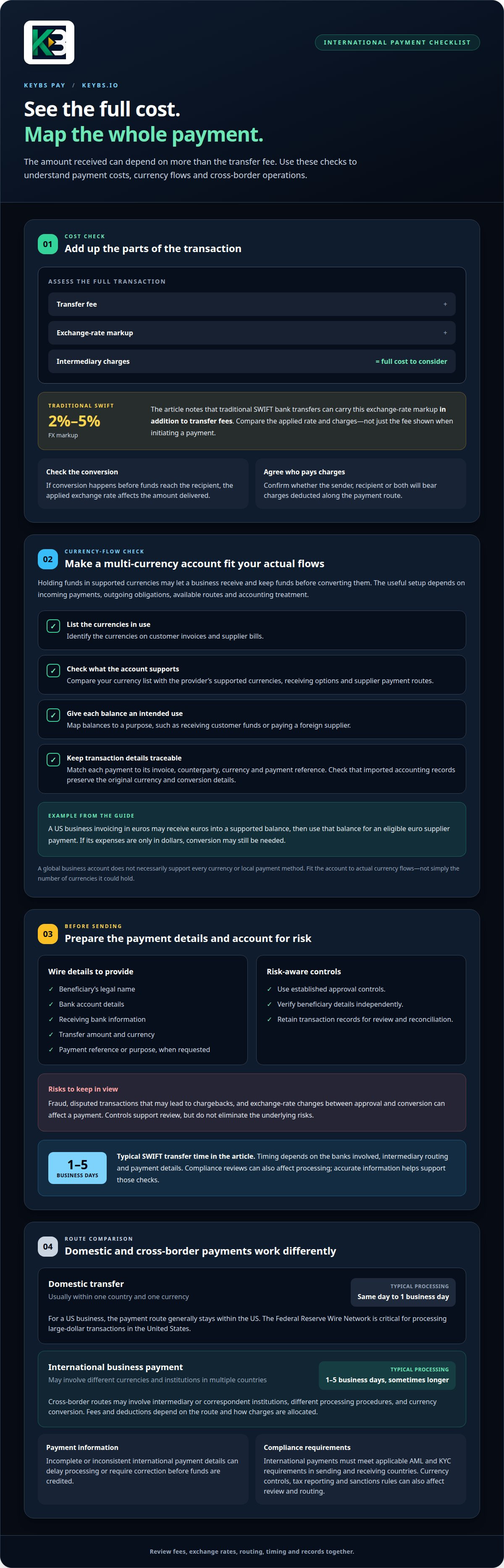
A foreign exchange markup is the difference between the rate applied to a payment and the mid-market exchange rate. Traditional SWIFT bank transfers can carry a 2% to 5% exchange-rate markup, in addition to transfer fees. The conversion method matters: when a payment is converted before it reaches the recipient, the applied rate affects the amount delivered. Compare the rate and charges, not just the transfer fee.
Payment Risks and Exchange-Rate Changes
Payment risks include fraud, disputed transactions that may lead to chargebacks, and exchange-rate changes between approval and conversion. A payment could be delayed, challenged or converted at a different rate than expected. Use established approval controls, verify beneficiary details independently and retain transaction records. These steps support review and reconciliation, but do not eliminate the underlying risks.
The payment route and fee arrangement determine whether charges are deducted from the amount sent or received. When agreeing on the payable amount, confirm whether the sender, recipient or both will bear those charges.
For a business wire transfer, provide the beneficiary’s legal name, bank account details, receiving bank information, transfer amount and currency. Include a payment reference or purpose when requested so the recipient can identify and reconcile the funds.
SWIFT transfers typically take 1 to 5 business days. Processing depends on the banks involved, intermediary routing and payment details. Compliance reviews can also affect processing when transaction information requires examination; accurate beneficiary and payment details help support those checks.
Can I hold multiple currencies in one account?
Businesses can receive international payments through a multi-currency bank account or a global payment provider that supports multiple currencies. These arrangements may let a business receive and hold funds in supported currencies before converting them. The account’s currency range and payment network determine which balances and payment routes are available.
For example, a US business invoicing a customer in euros may receive euros into a supported currency balance instead of converting them immediately to US dollars. It can then use that balance for an eligible euro payment to a supplier. If its expenses are only in dollars, it may still need to convert the funds. The decision depends on incoming payments, outgoing obligations and accounting treatment.
Keeping the transaction currency visible supports reconciliation. Match each incoming or outgoing payment to its invoice, counterparty, currency and payment reference. If accounting software imports transaction records from a payment platform or bank, confirm that the records preserve the original currency and any conversion details. Otherwise, finance staff may need to enter or reconcile those details separately.
A global business account is a payment-account arrangement designed for international business activity. It does not mean that every currency or local payment method is supported. Its practical value depends on available currencies, receiving options, supplier payment routes and accounting records. Choose an account structure that fits the company’s actual currency flows, not just the number of currencies it could theoretically hold.
- ▸List the currencies used on customer invoices and supplier bills.
- ▸Compare that list with the currencies supported by the account or provider.
- ▸Map each balance to its intended use, such as receiving customer funds or paying a foreign supplier.
- ▸Review accounting records for transaction currency, converted amount and payment reference.
Mapping your payment flows helps distinguish a useful multi-currency method from an account that adds complexity without matching the business’s needs. For companies paying suppliers in several currencies, align balances, payment methods and accounting records in one controlled process.
Differences between international and domestic payments
For a US business, a domestic transfer usually stays within one country and one currency. Domestic payments typically process the same day to 1 business day, while international business payments typically take 1-5 business days, sometimes longer. That timing difference can affect supplier schedules and the point when finance teams can reconcile an invoice.
Fees vary too. The total depends on the payment route, currency conversion and how charges are allocated. Comparing only the upfront fee can hide deductions made before the funds reach the recipient.
Cross-border transfers can involve institutions in multiple countries, each with its own processing procedures. Businesses should check that payment details are complete and consistent before sending an international transfer. Incomplete or inconsistent information can delay processing or require correction before funds are credited. A domestic transfer, by contrast, generally follows a payment route within the US.
Compliance is another operational difference. International business payments must meet applicable anti-money laundering and know-your-customer requirements in sending and receiving countries. Countries may also have different rules for currency controls, tax reporting and sanctions. These factors can affect payment routes and the transaction information reviewed.
Domestic payment networks shape how US transfers are processed. The Federal Reserve Wire Network is critical for processing large-dollar transactions in the United States. International payments may instead involve cross-border networks and correspondent institutions. Available payment routes can affect how the recipient receives funds and how the business tracks payment status.
- ▸Compare domestic and cross-border fees, including conversion and deductions.
- ▸Allow for the longer 1-5 business-day international processing range.
- ▸Match the recipient’s country, currency and payment route to the transaction.
- ▸Keep payment purpose and beneficiary details consistent across invoices and transfer records.
International payment providers
A provider’s structure affects how a business sends funds across borders, converts currency and records transactions. Banks, payment platforms and foreign-exchange specialists can support different parts of this workflow. A business paying suppliers may prioritize outbound transfers, while one collecting overseas customer payments may need local payment methods and currency balances.
Payment frequency and amount also shape the operating model. Specialized business platforms or digital providers are options for regular monthly payments of $5,000 to $50,000. For lower-frequency transfers, existing banking arrangements may be more practical. The relevant comparison is not a provider’s market reach alone, but whether its supported routes and controls fit the business’s sending and receiving requirements.
Assess the workflow across five areas:
- ▸Payment direction: Can the business collect from customers, pay suppliers, or both?
- ▸Currency handling: Which currencies can be received, held or converted, and when does conversion occur?
- ▸Payment methods: Can the recipient receive funds through a usable local route?
- ▸Records: Do transaction records show the original currency, converted amount and payment reference?
- ▸Controls: Can staff apply approval and review procedures to outgoing payments?
Exchange rates are only one part of the comparison. A platform may simplify recurring payments, while a traditional banking route may fit an existing treasury structure. Consider how each option handles payment instructions, beneficiary details, foreign-exchange conversion and reconciliation. The right structure depends on your currencies, counterparties and internal processes, not on a broad claim of global coverage.
For a business reviewing its cross-border payment workflow, map your international payment requirements against collection, supplier payment and currency needs.
KeyBS Pay: Payment Links
KeyBS Pay offers Payment Links for businesses that need a direct way to request customer payments. Payment Links support collection workflows, while Supplier Payments handle outbound payments to suppliers. E-Invoicing and Checkout also support customer billing and payment workflows.
Choose a tool based on the direction of the transaction: use Payment Links to collect payments and Supplier Payments to pay suppliers. This distinction helps separate incoming customer funds from outgoing obligations without treating a collection tool as a currency account or a settlement guarantee.
For businesses reviewing how customer payments fit their cross-border workflow, visit keybs.io to explore KeyBS Pay’s Payment Links.
Make your payment process easier to govern
Set a clear operating model before expanding cross-border payment activity. Assign responsibility for approving transactions, maintaining beneficiary records and reconciling payments, then document how to escalate exceptions. A consistent process helps finance teams distinguish routine transactions from those needing additional review, without relying on informal handoffs.
Managing international payments for businesses also means aligning payment collection with how your team invoices and serves customers. KeyBS Pay offers Payment Links, E-Invoicing and Checkout for customer payment workflows. Consider these tools when reviewing how payment requests, invoices and checkout fit into your existing process.
In your next review, identify one workflow that needs clearer ownership or better alignment between billing and payment collection. Then assess the operational tools that address that specific need.
Contact KeyBS Pay to discuss your payment workflows. A deliberate next step can help your team build a process that supports its business requirements.
Frequently Asked Questions
Quick answer: What are international business payments?
International payments for businesses are transfers between companies in different countries, often involving different currencies and payment systems. For example, a US company paying an overseas supplier may send funds in the invoice currency or convert them to another currency. The route, recipient details and currency handling shape how the transfer is processed and recorded.
Are traditional banks good for international payments?
Traditional banks can suit companies that already manage treasury and payment controls through their banking relationships, especially for occasional transfers. Their processes may also fit existing approval and accounting procedures. Before choosing a route, compare how it handles the required currency, beneficiary instructions and payment tracking. The right fit depends on your transaction patterns and operational needs.
Can my bank account receive international payments?
A bank account can receive international payments if the institution supports the relevant incoming payment method and currency. For example, a US business receiving funds from an overseas customer needs instructions that identify the correct account and receiving institution. Account capabilities, supported currencies and the payment route determine how funds are credited and shown in account records.
How fast are international payments processed?
International business wire transfers typically take 1 to 3 business days, though they can take up to 5 days. Processing time depends on the payment route, banks involved and whether transaction details require review. Distinguish between a transfer being initiated, processed through the network and credited to the recipient, since those are separate stages.
How to ensure compliance in international payments?
Build compliance into payment approvals and recordkeeping. Businesses must meet applicable anti-money laundering and know-your-customer requirements in sending and receiving countries. Keep invoices, payment purpose, beneficiary details and transaction records aligned so reviewers can connect each transfer to its business activity. Maintain a consistent approval trail and retain receipts to support accounting, reporting and audit work.
How to optimize cross-border transactions?
Assess each payment by the amount the recipient receives, the processing route and the effort required to reconcile it, not just the transfer charge. Where practical, match invoice currencies with expected expenses to reduce unnecessary conversions. Standardize beneficiary records and payment references for recurring transactions. Consistent supplier identifiers, for example, help finance teams match outgoing transfers to invoices and investigate exceptions without relying on informal notes.